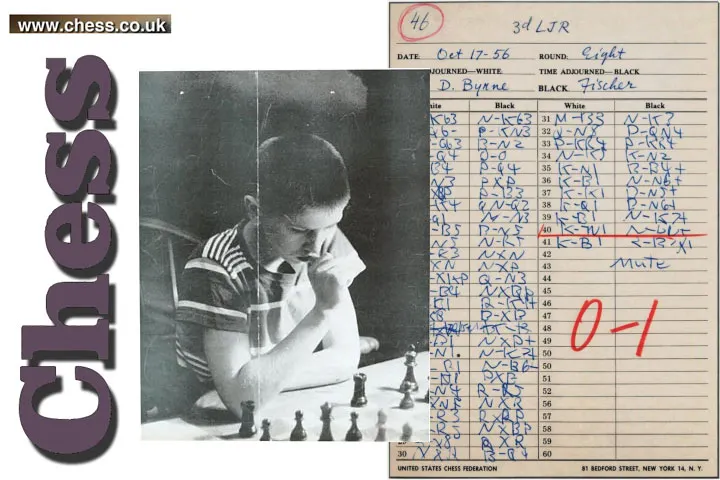
On October 17, 1956, a young Fischer faced Byrne, an experienced amateur and professor at Penn State University who had won the 1953 US Open. The game unfolded with a stunning sacrificial assault that left Byrne believing he stood better until Fischer's decisive move at 17. Even Byrne never fully grasped the depth of Fischer's combination in the moment.
Hans Kmoch immortalized the game by dubbing it the Game of the Century in the December 1956 issue of Chess Review, and the title endured. The brilliance of Fischer's victory reverberated far beyond America, capturing the attention of Soviet chess magazines as officials began compiling a file on the rising American talent. Before this game, Fischer was virtually unknown outside New York, but afterward, everyone in the chess world knew his name.
Fischer's meteoric rise accelerated throughout 1956 after he enrolled at Jack Collins' Hawthorne Chess Club in June. Earlier that summer, he had dominated the US Junior Championship in Philadelphia at just thirteen years old, earning his first chess magazine cover in Chess Life. The Canadian Open followed in late August, where he finished among the top places alongside strong competition.
Surprisingly, when Fischer compiled his landmark anthology My 60 Memorable Games in 1969, he excluded this historic Byrne victory. His reasoning was characteristically practical: he had already published the game with annotations in his 1959 book Bobby Fischer's Games of Chess, and he saw no need to reproduce it again despite its commercial appeal and the potential for deeper analysis.
The impact of this single game cannot be overstated. Within just over two years, Fischer became the world's youngest grandmaster and was already being discussed as a future world championship contender. The game served as his calling card, announcing to the chess world that a formidable talent had arrived. What began in October 1956 as one teenager's brilliant victory would eventually reshape the landscape of competitive chess for decades to come.