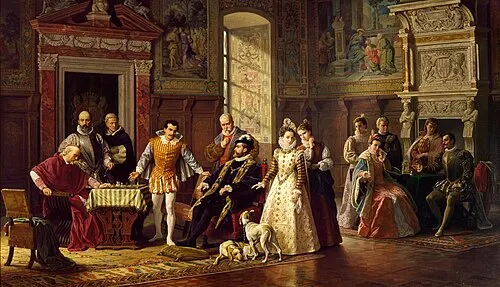
The opening that carries Ruy López's name did not actually begin with him. A Latin manuscript known as the Göttingen manuscript, written sometime between 1490 and 1505, contains the first recorded appearance of 3.Bb5. The text discusses twelve openings and shares material with work by the Spanish player Lucena, showing how quickly this move had captured the chess world's attention in those early decades.
Rodrigo López de Segura was a Spanish priest born around 1530 in Segura de León. His 1561 book, the Libro de la invencion liberal y arte del juego del axedrez, established his reputation as a founder of opening theory and contained 66 games. The irony runs deep: López recommended that Black avoid the line entirely by playing 2...d6, meaning the man who gave the opening his name was effectively warning players away from it.
The opening's genius lies in its restraint. When White plays 3.Bb5, the bishop attacks the knight defending e5, but cannot win that pawn by force. Any attempt to seize it through 4.Bxc6 dxc6 5.Nxe5 runs into 5...Qd4, which strikes both the knight and the e4 pawn. The Ruy Lopez operates through constant pressure rather than concrete threats, forcing Black to find precise moves repeatedly.
The Marshall Attack became the opening's legendary moment. In 1918 at the Manhattan Chess Club, Frank Marshall played 8...d5 against José Raúl Capablanca and lost the game, yet the line endured. Popular history claims Marshall had preserved this weapon since Capablanca defeated him in 1909, though historians have found earlier examples and Edward Winter considers the story unproven. Regardless, the narrative has become part of chess lore.
Modern players at the highest levels continue testing the opening. Levon Aronian and Ding Liren have employed it, and the draw rate shows how well Black manages the position. White has developed alternatives like 8.h3 and 8.a4, with Kasparov notably using the latter against Nigel Short in 1993.
In 2000, Vladimir Kramnik arrived in London to challenge Garry Kasparov for the world title and produced a transformation. Kramnik deployed the Berlin Defence, an obscure Ruy Lopez variation that had fallen into disuse, in games 1, 3, 9 and 13. Kasparov could not overcome it, Kramnik won the match and the defence became central to modern chess. The opening endures because it poses questions without demanding immediate answers, meeting beginners and world champions alike at the same crossroads.